
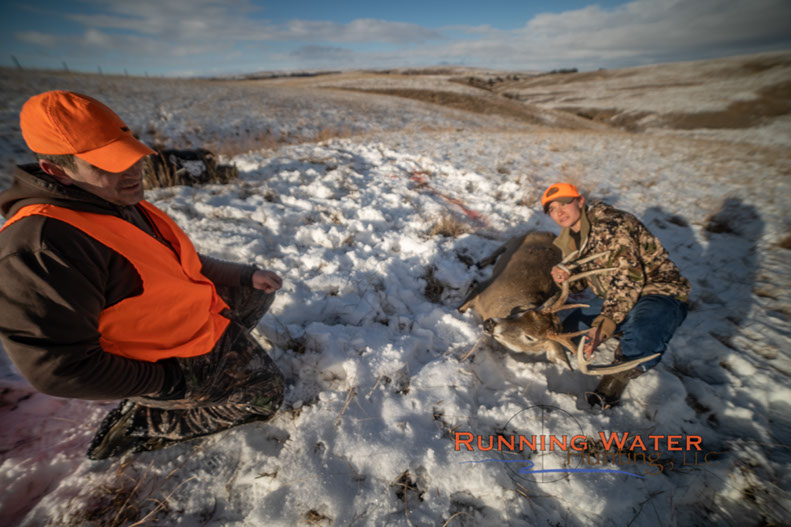
WHITETAIL HUNTS
With the exception of using calls/decoys during the rut, we hunt all of our whitetails on their transition areas from the feed to bedding. Archery hunts will all be out of tree stands or blinds, while muzzleloader hunters will typically be out of blinds with some opportunity for being more mobile for ambushing. We're typically looking at whitetail deer ranging from 120"-150", with the occasional few over 160". We do impose a 120" minimum. All hunts are 5 full days of hunting.
Our archery season runs from September 1-December 31 which offers awesome flexibility. However with muzzleloader season, we typically offer slots from September 1st through November 25. The first week of September can be great with the bucks still having their velvet on and patternable. The downside to early season is the crops are still up, specifically corn, and higher temps can make for slower activity. After the bucks shed velvet they typically get tougher to hunt but certainly still achievable. We start picking the bucks back up mid-October to the pre-rut as they get more exposed and start emerging out of the crops then we start rut hunts Nov-1 through the 25 where new bucks start showing up and rut activity is in swing.
Muzzleloader season runs from December 1-31 during the cold post rut. This is a favorite time to hunt for many because of the numbers of deer that move in for the winter, so new bucks we've never seen can move in at any time. We're typically sitting in ground blinds with heaters for the morning and evening transitions from feeding to bedding and visa versa. Hunters typically see a lot of deer on these hunts and can look at a number of bucks before deciding what they want to harvest.
MULE DEER HUNTS
The mule deer are iconic in the west and a prized animal by many hunters. While we do have a population of mule deer, the ratio to whitetail is about 2/3 to 1/3, so hunters shouldn't expect to only see mule deer. Because of this we really limit the number of mule deer hunters that we take in per year. Our mule deer hunts are typically spot and stalk/ambush hunting but we also take advantage of ground blinds when needed. The early season can be tough for mule deer in our area because they are so spread out during the warmer months. We recommend late October or the month of November for the most mule deer movement for archery hunting. During the late season with a muzzleloader we hunt mule deer the same way as whitetail, typically in their transition areas. We're typically looking at mule deer ranging from 140"-160" with the few exceptions each year being 170".
Archery Whitetail Hunts - Guided and Semi Guided options
Archery Mule Deer Hunts - Guided only
Muzzleloader Whitetail and Mule Deer Hunts - Guided only
Combination opportunities - Mule Deer/Antelope
Call/email for pricing - Whitetail/Antelope
- Mule Deer/Whitetail
*Pricing does not include sales tax
*Our mule deer hunts are also valid for whitetail harvest in place of mule deer. Mule deer harvest is not valid for a whitetail hunt. Fees will apply if mule deer is harvested under a whitetail hunt.
*Hunts exclude: Tags/license fees, meat processing/shipping fees, trophy mounting/shipping fees and hunt travel fees or additional personal expenses occurring before, after or throughout the hunt.
*We have a drawn blood policy. If an animal is fatally hit but not recovered, the hunter may not continue hunting another animal. Determined by the guide and/or landowner.
*Safety harnesses must be worn in all tree stands. No exceptions.